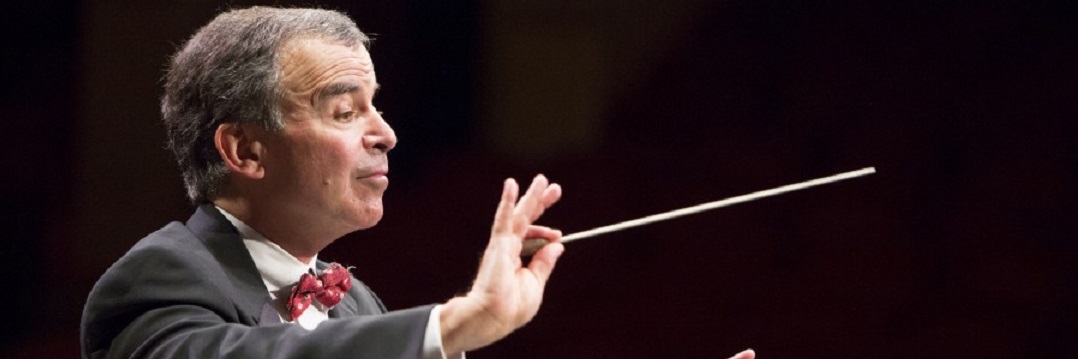
Calling all string players! Our May 8 workshop, At Home with the San Francisco Chamber Orchestra, is designed to inspire you and boost your playing to a new level. SFCO calls itself “San Francisco’s friendliest ensemble,” and good-humored conductor Ben Simon sets the tone. We talked with Ben recently about his life as a violinist turned violist, about why he switched to conducting (“the dark side,” he joked), and what we can expect from the May 8 workshop.
Tell us about your musical beginnings. When did you first pick up an instrument?
My mother had been a cellist and pianist who quit music in high school to spite her mother, and regretted it later. She was determined that all four of her children would have music in their lives. And we do! My brother’s a percussionist, one sister plays flute, and my other sister plays the cello. But I’m the only one who became a professional musician. I began taking violin lessons when I was 6.
When did you switch from violin to viola?
I spent my first eight years in San Francisco, and my first violin teacher—Manfred Karasik, who played with the San Francisco Symphony—was actually a violist. We used to play Béla Bartók duos together. My family moved to New York, and I continued to study violin there. We returned to the Bay Area when I was 15, and when I left again, to attend Yale, Karasik gave me a viola and said, “This might come in handy.”
And did it?
It did, but not at first. I was pre-med at Yale, with no intention of becoming a musician. But I missed the violin so much that I dropped my pre-med studies and became a music major. During my second year, the Yale School of Music hired Raphael Hillyer, a brilliant violist who’d been the Juilliard String Quartet’s original violist. I was very lucky: He took me on as a student—it was a turning point in my musical life.
While I was still in school I auditioned for the New Haven Symphony Orchestra, which used students as well as professional musicians. There were a lot more violinists than violists, and the conductor asked whether any violinists played viola. In my youth and inexperience I said yes. I got the job as a violist, and I’ve never looked back.
What appeals to you about the viola?
Many composers have called the viola the intellectual voice of a string quartet. You’re playing the inner lines that control the rhythm and harmony. Also, the sound is richer and more mellow than the violin, and you don’t have to worry about that pesky E-string. It suits my personality really well.
How about conducting? Does it also suit your personality?
I’ve always been interested in score-reading and analysis. I had studied conducting since high school and had conducted a few little things here and there. Then, in my mid-40s, I became the director of The Crowden School in Berkeley—I succeeded Ann Crowden, the founder. The best part was getting to conduct the school’s orchestra. It was my first time conducting since college, and I loved it! In 2002 I was offered two jobs: as music director of the Palo Alto Chamber Orchestra, a fabulous strings-only youth orchestra; and as the conductor of the professional San Francisco Chamber Orchestra. I’m more of a mentor and coach than a boss—we’re all friends. I make the process as collaborative as possible.
And have you continued to play the viola?
I practice every day, and I play with friends and colleagues when I can.
We’re thrilled that the San Francisco Chamber Orchestra will play for us in the May 8 workshop. Will you be performing together or in separate Zoom rooms?
We’ll be together, live, at the composer Paul Dresher’s studio in West Oakland. It’s an industrial warehouse with some renovations that make it sound better, and with wonderful theatrical lighting. We’ll run through the Praelude of Grieg’s Holberg Suite together, and then the section leaders will talk about the musical challenges of each individual part. At the end, we’ll go back to the top and do a little performance together. It’s a brilliant movement, and everyone gets a chance to shine.
You’ve played in orchestras and string quartets. What’s the main difference?
Playing in orchestras is a good way to make a living and a terrible way to make music. Playing in string quartets is the opposite: a great way to make music—it’s a collaborative effort—but a very difficult way to make a living!