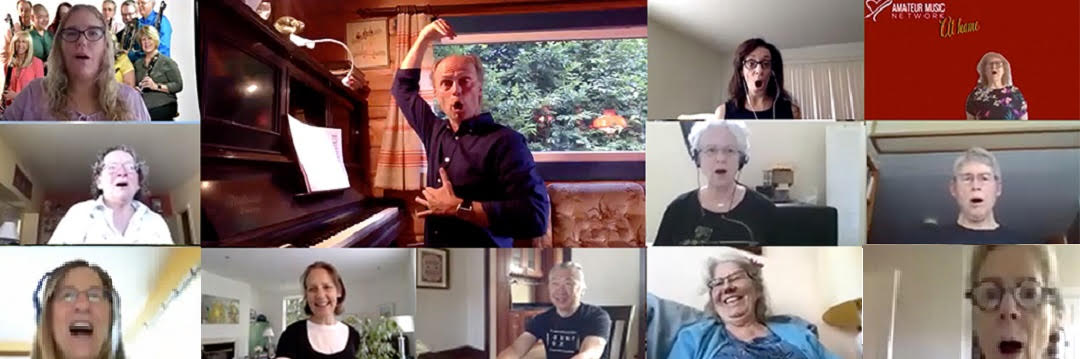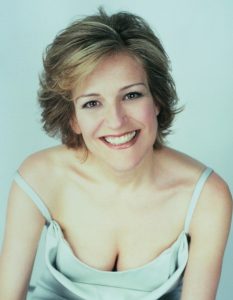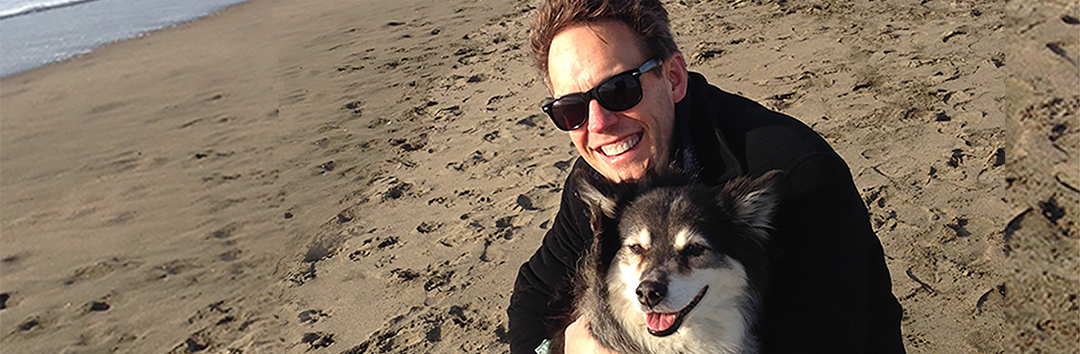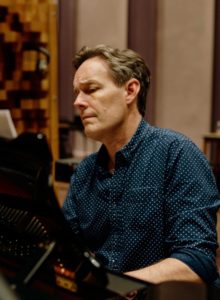
Our Singing Saturdays with San Francisco Symphony Chorus Director Ragnar Bohlin have been hugely successful—thank you for joining us! We thought you’d like to know more about Ragnar, so on a recent morning (evening in Stockholm, where Ragnar has lived since the early days of the pandemic), Amateur Music Network founder and director Lolly Lewis chatted with him via Zoom. Their conversation was far-ranging and fascinating. We’re publishing it in three parts, and welcome your further questions in the comments section.
Tell us a little about your early musical life. Did you sing in choirs?
I grew up [in Lund, Sweden] with music all around me. Both of my parents were choir directors. My father was a musicologist who led the Lund Male Choir. My mother was a mathematician who changed careers and started a choral movement in Lund. Her choirs won many international competitions. She had us children sing and pay music all the time. I studied piano from age 5, and cello from age 8. When I was 13, my mother talked me into learning to play the organ. At that point I was more into pop music, but she convinced me that playing the organ would be a good way to earn pocket money.
And was she right?
She was! I started quite early working as a church organist. Meanwhile, I went to a music high school where I tried to do everything—singing, piano, organ, cello. I led my first choir when I was 16.
What kind of pop music did you like? Do you still listen to pop?
I’m a musical omnivore. I love all styles. I grew up with classical music all around me. When I was tiny, my mother gave me a tape with Mendelssohn, Bach, Mozart, Wagner, Verdi.. I listened to it, mesmerized, from age 3 to 7 or 8. Then I discovered the Beatles, then Supertramp, Queen, Rush, jazz-rock, symphonic rock, eventually Kate Bush, Bjork. All the styles inform one another, not directly, but by being different. The specifics of each genre become more clear because you have a contrasting style.
Let’s go back to your musical education. What happened after high school?
I got a scholarship to study piano with Peter Feuchtwanger in London. Then I had second thoughts and came back to Stockholm in 1985—I was 20 at the time—to begin an organist course at the Conservatory of Music. I never regretted my decision, because it enabled me to keep having a broad scope that included conducting, singing, counterpoint, harmony, theory. At the time, conducting was one of my least favorite subjects! I loved singing in choirs, but I hated standing up in front of them.
What changed your mind?
I got a part-time job in a church while I was a student, and I had my own choir there. At the Conservatory I sang under the grand master Eric Ericson, the conductor of the Conservatory chamber choir. Ericson was my main inspiration, and after I completed the church music degree I spent another four years studying conducting, and received a diploma in choir conducting. I sang in the Ericson Chamber Choir, and I’ve now conducted them, and the Swedish Radio Choir, several times. I’ll conduct them again in December, when they sing the Bach Christmas Oratorio with the Nordic Chamber Orchestra.
When did you know you would make a career of directing choirs?
My interest in choir directing grew out of my piano playing, leading from the piano. Piano was always my main thing, although for a while I became obsessed with the voice and aimed to become an oratorio singer as a side career. I have sung the Evangelist part of the St. Matthew Passion, Bach’s Magnificat, Rossini’s Stabat Mater, and much more. I studied for five years with the famous tenor Nicolai Gedda, and I accompanied a lot of master classes, both as a singer and as a pianist.
And you lead Singing Saturdays from the piano.
It’s something I’ve done for years. There are certain things you can do better when you lead from the piano. You’re in full control of the flow of the music and the rehearsal process.
Next: Part 2 of our conversation with Ragnar Bohlin, on making music during the pandemic.
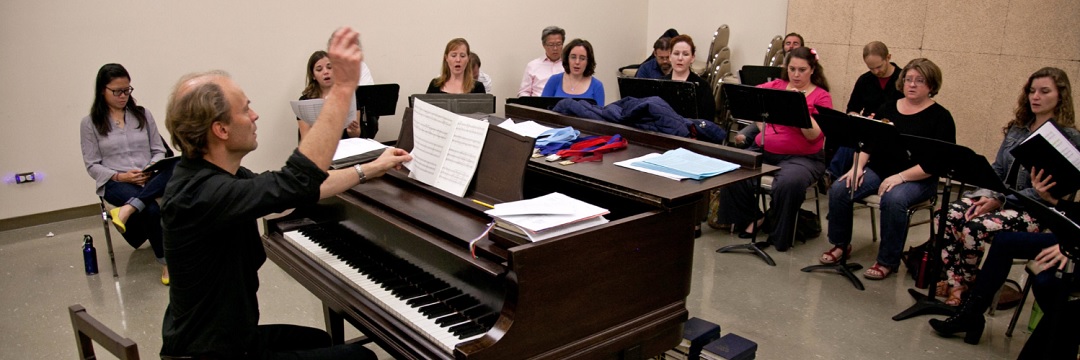
Pictured: Ragnar leading a rehearsal with his professional chamber choir Cappella SF.