Author: Lolly Lewis
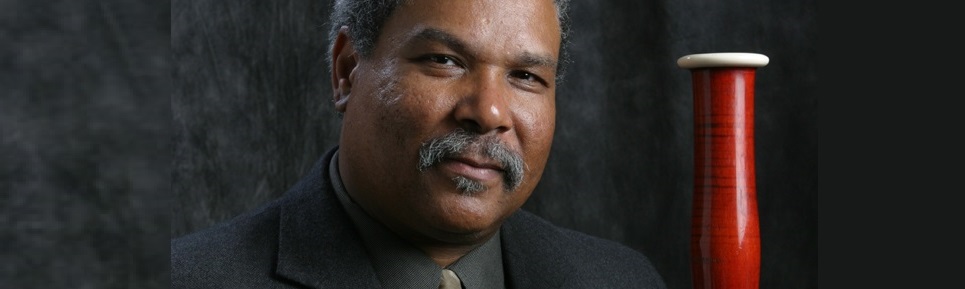
This is a guest post by Nancy Friedman, an AMN volunteer.
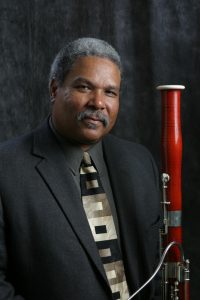 We hope you’ve registered for our October 10 online conversation about “the musician’s toolbox” with
the accomplished and delightful Rufus Olivier Jr. A consummate musician and educator, Rufus is
principal bassoonist with the San Francisco Opera and the San Francisco Ballet, and a former member of
the San Francisco Symphony. We chatted with him on a warm September afternoon while he was taking
a break from a nonmusical activity: painting his house in Sonoma County, California.
What is “the musician’s toolbox,” and how can amateur musicians use it?
I came up with the idea of the musician’s toolbox when I had to give a talk to some high school kids. I printed up some signs and brought them in a little Craftsman toolbox—that’s right, a literal toolbox. On each piece of paper was something a musician needs to practice to get better: long tones, scales, arpeggios, etudes, and so on.
What’s an example of one of these tools?
Long tones are one of the most important tools, especially for a wind player. They get you in touch with your instrument—you’re breathing through it, and it becomes an extension of you. It may seem like a boring exercise, but it may the most useful and important one. After a while it almost becomes a meditation.
When was the last time you performed for an audience?
Opening night of the ballet’s “Midsummer Night’s Dream” was Friday, March 6. It was also closing night—after the performance there was an announcement that the city of San Francisco was shutting down because of the pandemic. The following Tuesday they let us back into the Opera House, and we made a video for ticketholders. It’s really good! I really enjoyed being able to listen to the orchestra without my brain constantly on what I’m doing. [Watch a one-minute excerpt from the recording.]
How have you spent your time since the shutdown?
I’ve been performing since I was 15, and I’ve been with the ballet and opera for 43 years, so the shutdown has been like a long weekend off. I painted my house, fixed my lawnmower, got my motorcycle working. I’ve also continued teaching—one of my Stanford students did her whole graduate recital online, with her family members accompanying her. It was great!
I’ve also made a ton of videos. I get up in the morning, practice, and make a video. [Watch Rufus Olivier Jr.’s video for Music in May, a festival in Santa Cruz that was canceled because of the pandemic.]
How is online teaching working out for you?
It’s definitely getting better. Zoom is getting better! I was even able to play a duet with one of my students on Zoom
This is a guest post by Nancy Friedman, an AMN volunteer, who writes:
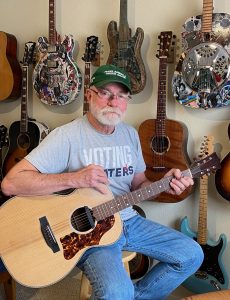 “I’ve known Ken Smith as a friend and a photographer for many years, and I’ve enjoyed his Instagram posts and music videos. When I learned that he’d posted a listing on the AMN website, I saw an opportunity to learn more about his musical life and to share our converstion with the AMN community.”
Your listing says you’re a singer-songwriter and rhythm guitar and fingerstyle player. What led to these interests? Did you grow up in a musical family?
My father was in the US Air Force, so we traveled around a lot. My family wasn’t musical, but there was music in the house—mostly Big Band records and country-western radio.
When I was in fourth grade, in Hutchinson, Kansas, students had the opportunity to learn a musical instrument. I thought it would be cool to play drums, but my mother said no. I ended up with a clarinet, but I hated the taste of those reeds! I switched to French horn, but carrying it back and forth to school was too much for me, so I gave up.
By the time I was in high school we were living on the air force base in Newfoundland, Canada. Some guys I knew had formed a band, which sounded like fun. I bought a $13 guitar from the Sears catalog and taught myself to play some chords. But the guys needed a bass player, so I went back to the Sears catalog, bought a bass guitar, and told the guys they’d have to teach me how to play it. We got good enough to play Saturday nights at the teen club on the base. The four of us made $55 a gig. So I guess I was a professional musician for a while!
Are you mostly self-taught? Have you taken any formal lessons?
In high school, we taught each other. It was like the famous story about the Beatles traveling across Liverpool to learn the B7 chord. Wow, a new chord!
In the late 1990s I started taking individual and group classes in jazz guitar and lead guitar at the Blue Bear School of Music in Fort Mason. My teachers there included Jim Peterson; Joe Cunningham, a great guitarist and quiltmaker;
and the late Johnny Nitro of the San Francisco band Johnny Nitro & the Doorslammers. More recently, I’ve twice traveled to Portland, Oregon, to take workshops from the fingerstyle blues guitarist Mary Flower—a wonderful musician and generous teacher. Mary introduced me to the music of Duke Robillard, Albanie Falletta, Guy Davis, and other terrific blues guitarists.
When did you start writing your own songs? What inspires you?
I started writing lyrics in 1974 or 1975, when my first marriage was breaking up. But it took me more than 40 years to put them to music. I learned by listening to songs I liked and studying their structure. I have a limited vocal range—maybe an octave at most—so I pick keys I can sing in.
In 2017, we were displaced for 10 days by the fires here in Santa Rosa. During that time I started writing about the experience, and what came out was “Firefighter in the Smoke.” For the lyrics, I wrote down every word I associated with fires and firefighting, and then started putting them into couplets.
I earned a living for many years as a corporate photographer and videographer, so it was only natural that I’d start making music videos—my own songs, like “Raven Blues,” and traditional songs, like the Irish folk tune “Drill You Drillers,” which was inspired by the soil-sampling crew in my Santa Rosa community!
Tell us about the guitars you’ve built and restored.
I’ve made five guitars from scratch and repaired about 35. I’m self-taught in that area, too—I watched a bunch of online videos. My first guitar was made from Adirondack spruce, mahogany, and, for the neck, pau ferro. I made another guitar from Tennessee sweet gum, Engelmann spruce, walnut, and rosewood. I don’t do inlays—it’s too persnickety.
And then there are all the guitars I’ve repaired and kept. In the room I’m sitting in right now there are 31 guitars.
I haven’t yet made the perfect guitar, and I don’t think I ever will. But that doesn’t keep me from being obsessed.
Raven Blues by Ken Smith from Ken Smith on Vimeo.
This is a guest post by Nancy Friedman, an AMN volunteer.
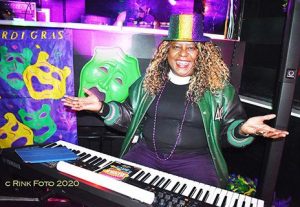
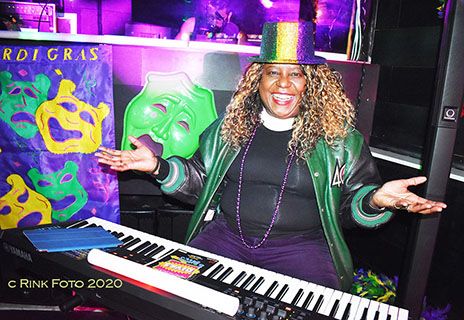
On August 15, the multitalented Dee Spencer—teacher, performer, music director—will offer an online workshop in jazz-piano improvisation through our Amateur Music Network at Home series. We caught up with her by phone just before she headed out to an evening gig at San Francisco’s Catch restaurant, which had recently reopened for outdoor dining.
What was your early musical life like?
I grew up in a musical family in Wilmington, Delaware. My dad sang, my mom sang. Dad was a huge opera fan, Mom listened to gospel music, my sisters listened to Motown. One of my uncles came to live with us, and he introduced me to jazz. When I was 7 or 8, my mother bought an upright piano and said, “Here you go.” I took classical piano lessons and became the designated accompanist for the family. In junior high and high school I wanted to be in the band, so I switched to woodwinds. I got a four-year oboe scholarship to Florida A&M University, in Tallahassee, and then ended up doing more keyboards than oboe! I became a piano minor, and while I was still in college I got a job at Epcot playing keyboards with a jazz/rock combo and accompanying the singers in the stage shows.
How has the COVID quarantine affected your performing and teaching life?
I teach jazz and musical theater in San Francisco State University’s School of Theatre and Dance. Fortunately, I’d already taught online. What’s changed is that all 18 weeks of instruction have to be complete before I click and launch on August 22. It’s intense! Also, obviously, we can’t do our productions in person yet—everything’s going to be online. It’s a different game, applauding for someone you can’t really see. But a lot of people are doing a really good job with virtual productions.
I’ve used the quarantine to do some songwriting, too. I was music director of One Mo’ Time, and my favorite song from the show is “Cake Walking Babies (from Home).” That was my inspiration for “Quarantine Cakewalk.” It’s a sheet-music exercise—you have to play it exactly as written. It’s not an improvisational exercise at all! [Editor’s note: Read about the history of the cakewalk. Go to our Workshop Resources page to listen to and download the sheet music for Dee Spencer’s “Quarantine Cakewalk.”]
Tell us something people may not know about you.
I wrote our high school class song, “What Do We Have to Offer?” It got mixed reviews—my classmates said it “wasn’t happy enough.” But the band director and the choir director liked it, and that was good enough for me!
Something else people may not know is that I play third clarinet in the San Francisco Lesbian/Gay Freedom Band. I really like playing third clarinet—you get the lower notes, and you get to hear what the other instruments are doing. I like sitting in the back row—it’s so interesting to blend in with the trombones.
What can participants expect from your AMN workshop?
I’m an improviser, so I can go just about anywhere. I have various game plans, and I’ll see what everyone’s expecting. Are they new to improvisation? Do they already have experience? I want my audience to be engaged—to work hard and have a robust experience and also an enjoyable one.
It seems like COVID has forced all of us to become improvisers. Can you give us some professional advice?
Learning to improvise is a good thing! You discover things about yourself and the world. You’re taking a risk, and that’s good. It’s always good to stretch.
Register now for At Home with Dee Spencer, August 15 at 2 p.m. We may have time for one or two people to play for the group during the workshop. Please contact us at info@amateurmusic.org for more information.
This is a guest post by Nancy Friedman, an AMN volunteer.
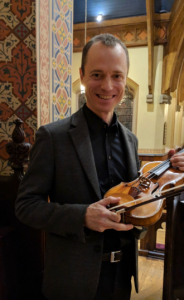
We were thrilled when Garrett Fischbach posted his teaching services to our online Listings. Not only does Garrett have 25 years’ experience with three of the most prestigious orchestras in the United States, but he also has a true passion for teaching adult amateurs. Furloughed along with the entire Metropolitan Opera Orchestra and Chorus since March 31, he spoke to us from his home in New York about his teaching and performing philosophy.
What can students expect from your lessons?
I teach enthusiastic intermediate and advanced violin and viola students of all ages who want to improve their skills, either to perform with friends or community orchestras or simply to get more pleasure out of playing.
As the song goes, “If you become a teacher/By your pupils you’ll be taught.” What is something you’ve learned from a student?
I recently went through old files and came across a folder of essays written by my undergraduate Violin Performance students at Mannes School of Music [in New York] in 2010. I had asked the students to write a paragraph or two about their short- and long-term career goals, and one student wrote these very inspiring words: “The other possibility that I have been contemplating is to just live simply, and have the violin and music in general, as a gift to be cherished, rather than an obligation to be mastered.” A decade on, I couldn’t help wonder what this person was up to. I looked him up, and it turns out he has been doing exactly what he said in that sentence he wrote. He is in fact still playing the violin, but very much on his own terms in his own original way, while making a living doing a variety of other fascinating things. His example gives me much inspiration during these uncertain times.
We love the idea of music as “a gift to be cherished.” Can you tell us more?
In the MET Orchestra, we are of course always listening to great singers—both on and off the stage. The English mezzo Dame Janet Baker once gave an interview in which she said something about this idea of “gift.” She acknowledges that she is “gifted,” and says a friend told her that this gift “is hers to enjoy.” We are not all quite as gifted as Janet Baker, but even amateurs have a gift, and that is the love for the music they play. (Listen to the interview with Janet Baker.)
What is a common challenge amateur musicians face?
A lot of the time amateurs don’t realize just how much they can do. All they need is a little bit of prompting from someone who has the keys and opens the door to a lot of technical challenges that they thought were beyond their reach and also a lot of ways of thinking about the music. That’s what professionals can share with amateurs.
Learn more about Garrett Fischbach’s teaching services on our Listings page.